

 Lecture
How Do Active Cancer Diagnoses Affect Total Joint Arthroplasty Complication Rates?
There is currently a paucity of data analyzing total joint arthroplasty (TJA) disparities among patients with active cancer diagnoses.
Lecture
This lecture was published as a recording without a written summary.
7,006 words · 35 min
Thanks, everybody. Uh, thanks for taking some time to spend with us to learn a little bit more about Ayourvera. I think in the context of COVID and all the issues we're facing right now, uh, there's gonna be a tremendous amount of pressure, I think, on the back end of this whole epidemic, uh, uh, about moving cases, uh, from the Inpatient setting to the Outpatient setting. Because if you think about it, hospitals are gonna be struggling with COVID for some time. So it's not like we're just flipping a switch.
All of a sudden and the virus just disappears in 1 month or 2 months or whenever it is, hospitals are still going to be dealing with these patients and resources are going to be strained. So there's a lot of interest in looking at Surgery centers or HOPDs or trying to figure out how to get patients out of the hospital quickly, uh, number 1, to reduce exposure, but number 2, to enable the throughput.
And I'm sure the revenue issues that a lot of hospitals are facing are significant as well. So what are the strategies that we can deploy to really help a lot of these clinical issues, which then layer on top of all the Other financial and revenue generating issues that that we're all struggling with as well. So I think if we start building an ecosystem of clinical tools, this really will help us.
Deal with what we're gonna face on the back end of this. And so I want to focus on, uh, utilizing Technology Innovation such as Avera to start looking at, uh, improving our outcomes, uh, getting to the point where we have opiate-free Outpatient Total Knee Replacement. And so that's the context in which I want you to think about some of these topics.
There we go. Um, so I think most everybody on this call are, are sensitive to all the opioid issues that we were having, uh, pre-COVOVID. There's a significant number, there's a significant amount of data and Research, uh, that was being done previously, looking at the patients who are opiate naive going into a total Hip or Total Knee Replacement, and we see there's a significant amount of data now demonstrating that a number of these patients.
Patients are still on opiates at 369, and there's some now data that came out just a few months ago, that there were about 10% of patients still on opiates that were opiate naive going into a Primary Total joint replacement 15 months after Surgery. So you can make an argument in these patients who are opiate naive going into their arthroplasty, that we have actually potentially have done harm.
And so if we look globally at the literature, you can see on your screen here the impact of opiates and the impact of Pain, especially on those patients who are opiate naive going into all these various surgeries.
I think
We all appreciate the consequences of the adverse events related to opiate use. You can see here the financial and clinical consequences are nothing to be ignored. And so if we expect to make a dent in this, we've got to deploy new strategies and new technologies uh to really.
Minimize the issues that we face with opiates. So if we can reduce the amount of opiates being used, we can see the clinical improvement, whether it's Pain, whether it's adverse events. I think time to discharge and decreased costs. And I think a lot of this stuff is probably intuitive to a lot of the physicians on this call.
Now New Orleans or Louisiana, just like most of the Other states, a lot of Other states within the US have passed legislation to help, not necessarily help, but to force physicians or force providers to start getting their hands around this issue of opiate use. And so in Louisiana, we can only prescribe narcotics for a maximum of 7 days, no matter what, whether it's a Spine Surgery from C1 to L5, or if it's a little hangnail or
A Knee scope. Only 7 days' worth of opiate prescriptions are we allowed to prescribe. Now we've got to type stuff on the script to allow us to extend that, or you can play games with the with the uh the dosing and the timing of it, or what have you. But the point being here is you're starting to see a legislative crackdown on the management of opiates, and it's getting harder and harder for us to do this, and rightfully so. We need to take ownership of this, and we need to do a better job of managing Pain and managing opiates.
So, most of us, probably on this call that are doing a fair number of total joints, have developed our multi-modal treatment strategy, right, or analgesic program. So, a lot of it is based on local management of trauma, inflammation, and, and Pain mediators and Pain signals, prostaglandin E2, and a lot of Other uh uh cytokines and chemokines that are involved in that. Uh, we've got a central neurosystem, uh, pathway, uh, that we try to attack. You can see all the, uh, treatment strategies that we use there, and obviously, at the, uh, at the brain level of cerebral.
Level, uh, there are additional treatments and medications that we use. So I think the multimodal Pain management Protocols that we've all developed have become pretty robust and we've gotten pretty good at it. And so what are the additional things we can layer on to kind of turn the corner? We've kind of plateaued in terms of managing patients' Pain right now. And so what are the newer technologies, innovations that we can deploy to kind of turn that corner and get to the next level? And ultimately for me, the next level or the place that ultimately we all should be striving for.
Would be opiate-free Surgery or opiate sparing Surgery. Now, I'm, you know, I'm specifically talking about the uh narcotic, uh, naive or opiate naive patients going into a Total Knee Replacement, but I think there's an opportunity with aloe vera and Other things to start looking at patients with chronic opiate use as well. And so can we develop strategies just as aggressive we are intraoperatively, start looking at opportunities preoperatively to help these patients that are on opiates and narcotics going into uh arthroplasty, uh, from their arthritic symptoms.
So I'm gonna give you a little background about Ayour vera and and cold, and kind of what this is all about. And so cryotherapy is a local or general use of low temperatures in medical therapy. Now, cold has been around for a long time, and so, you know, we've all been exposed to cold and its impact on Pain, right? You fell as a little kid, uh, you hurt your wrist, you had a little boo boo, Mom put an ice pack on your arm, and all of a sudden the Pain got better, the swelling went down, and you went about your Business. And so how do we take.
That fundamental concept that we've all grown up with and leverage that in a new way that's useful for us, uh, clinically in this kind of uh modern day era of Medicine. So cold has been around, like I said, for a long time, and those of you who are old enough probably remember the liquid nitrogen tanks that were sitting in the basement of some of the hospitals, uh, we would use an eventual radiologist or whoever would use to target tumors or uh more significant Pathology.
The issue with that is it destroyed a lot of that tissue, and that's what it was meant to do. But over time, we started learning, uh, the physiology, chemical engineers, and, and understanding what different opportunities there were nitrous oxide came along. And so, the original company, Bioscience, and now Facera developed a handheld device that takes nitrous oxide and converts it from a liquid to a gas from a uh.
Uh, liquid to a gas, and we're going to talk about the mechanism of this to create essentially an area of cold or a zone of cold under the skin that we can then leverage to target various nerves.
So the Technology is basically made up of this handheld device. At the bottom here, there's a little tip, uh, what's called a smart tip that you can unscrew its spring loaded into the bottom. And then on the top here, there's an area where that we unscrew that we insert our nitrous oxide canister.
So the beauty of this system is it's percutaneous, it's handheld, and it really is, takes very minimal effort in terms of actually utilizing the Technology. It's kind of established billing code. It's clear to treat, uh, to treat Pain and symptoms of Osteoarthritis. If you can essentially target a nerve that manages Pain outside of CNS, you can basically go after it, right? And so it's on label and useful and approved by the FDA.
And so the two workhorse needles that we use is this needle that's called a 309, so it's three, essentially 27 gauge needles at the end. It's 8.5 millimeters long, and then we've got a long needle here that is 20 gauge, 90 millimeters long to target some of the deeper nerves, for example, the deep geniculate.
Or ah some of the uh the nerves around the Hip or suprascapular or Other branches that may be a potential target. But for the purposes of this talk and talking about Total Knee Replacement and and Knee OA and Knee Pain, we're gonna focus on the nerves around the Knee, anterior femoral cutaneous nerve and the branches of the intellar saphenous nerve.
So the way the system works is we insert a nitrous oxide cartridge into the top of that white device, and the proprietary part of this, the patent, covers the ability to convert that from a liquid to a gas. That gas then flows through that device and essentially cools down those three little needles that you saw, and we essentially create a tic tac sized ice cube.
Under the skin. That's it. There's no drug, there's no toxin, there's no chemical, there's nothing. All it is are 3 little needles getting very cold, and then that gas gets vented out through these needles, and then exits out through the handpiece. So again, this is one of those things, you know, one of these inventions where you kind of just kick yourself, just like uh the wound vac, you know, basically hooking a vacuum.
Cleaner up to a sponge, where, you know, this was invented where you just made 3 little needles get really cold, and all of a sudden now you have this tremendous clinical impact once you get your hands around the clinical aspects of this. So this is a diagram or this is a depiction of what it looks like. So this is an Agarose gel. You see the 3 needles, so this is pretend it's the uh the skin.
Pretend there are two nerves down here, so we're going to insert the needles towards those target nerves, and then we're going to basically turn it on, and it's going to make those three needles turn very cold, and then here's the ice ball that forms, and as that cold.
Interacts with the nerves, the nerves begin to shut down. And we're gonna talk a little bit about the physiology around this and why that's important, uh, because the way the nerves shut down is extremely important, what's different and what differentiates this from Other technologies like RF ablation and, uh, liquid nitrogen. So the key point here is if we go back to our neuroanatomy, back to medical school, is realizing and, uh, remembering that the important part of nerve regeneration is maintaining the epineurium, the perineum.
And the endoneum, because if you remember back to your hand rotation when you had a nerve laceration, what did your hand surgeon do? We didn't actually oppose the axons one by one to each Other, right? We just repaired the nerve sheath, which then allowed the nerve to regrow across the zone of injury. So again, the important part here is if we can maintain the integrity and the continuity of the nerve sheath, the epineurium, endineurium, and perineum, we can allow that nerve to regrow along its original path.
Without any issues, and so I'm going to demonstrate this in a little bit.
So if we look at the different ways we can injure nerves, I'm gonna start from the bottom and move our way up. You can see 5th degree transaction, which most of us know and appreciate, not anything we necessarily want to deal with. If we look at non-reverse the second version of non-reversal, uh, second type of non-reversible nerve injury, uh, this is what we see with burning and freezing with liquid nitrogen.
We get neuropsis, where you destroy not only the axon, but the nerve sheath. So again, this is what happens with liquid nitrogen uh when you get to temperatures below 140. Now, when we get to reversible nerve injury, this is where Ayourvera lives. So this is called axonatmesis, where we just disrupt the axon, but not the nerve sheaths. And I want to make a point here. Ayo vera cannot get any colder than this, because this is the boiling point of nitrous oxide.
OK, so it is physically impossible to get any colder than this and create permanent damage, because this is fundamentally the inherent property of nitrous oxide. This is the boiling point. So even if I wanted to, I couldn't. And so it's got this safety perspective built into this that you really can't compete with. And obviously, first degree neuropraxia, stingers and things like that that we see when those of us cover football games and things like that.
So the Other point I want to make here is I want to be very clear. You will hear about technologies like an RF ablation. Those technologies are on this side of the spectrum, OK? So they burn. They permanently destroy the neuroanatomy that they're targeting. All it is, is basically taking an RF probe that gets really hot and just dripping some saline on it to make it a little less hot.
So Ayoe vera is the only thing out there that actually gets cold, OK? So, there's a, a misconception in terms of how things are named, uh, you know, it's a, it's a, uh, intelligent Marketing, uh, uh, use of words, uh, for some of the Other technologies. But Ayoe vera cannot get any colder than this, whereas the Other technologies actually burn.
So despite the name, it actually permanently destroys the tissue there, and there's an important concept that I think everyone needs to take home, because if you permanently destroy the nerve sheath, you get aberrant nerve regrowth, and then you get rebound neuropathic Pain and all kinds of issues start coming up, and this is what we see with a fibrillation from the.
Pain management world when they were when they ablate the nerves around the facet joints and Other areas that you create sometimes in some patients more problems, and Ayovera does not do that. So the nerve sheath is maintained, only the axon goes. And so this is a kind of a a depiction of what that looks like. So here's the myelin sheath in the axon.
Ah, and when you introduce the cold air, only the myelin sheath goes away, the Schwann cells, ah, whereas the nerve sheath is maintained, and then it regrows along the original path and reinnervates the original tissue, the way it should.
And so if we look at some of the histo and the basic science around this, ah, you can start to appreciate some of those points. So this is an untreated nerve. This is an axon, so you can see the uh the axons on cross section and longitudinal section. You can see the nuclei here, so this is a normal looking nerve.
Now when we treat the nerve with aloe vera, when we freeze it to that temperature, what do we see? So all of a sudden all the axons are gone. You can see all these empty vacuoles here, but the most important thing I want to point out here is the nerve sheath is completely maintained, OK? So at that temperature, only the axon is sensitive to this and the nerve sheath is completely maintained, so we get that reproducible nerve regrowth that we're looking for.
So this is immunohito. So the axons are green, blue are the macrophages. So we have an untreated nerve here. You can see the axons arranged as we would expect. If we freeze the nerve, what do we see? All of a sudden 2 weeks later, all the green is gone, and what are we seeing? We're seeing blue, so the macrophages are coming in. They're cleaning up as we would expect. At 4 weeks we start to see the axons growing back in their original location, and at 8 weeks you start to see these axons coming back in the exact same spot that they were in previously.
OK. The Other question I get asked a lot is, what about the surrounding tissues around that ice ball? And so sebaceous glands, hair follicles, whatever it is you're concerned about, they are not affected at that temperature. So again, for whatever reason, the way Mother Nature set this up, at -88, none of the surrounding tissues get impacted. The Other question I get asked a lot is about the vascular structure. So what about arteries? So if I march that ice cube and it gets closer to an artery, am I gonna freeze the artery and then all of a sudden, uh, create more problems?
So remember, cold and heat are two different things. So heat, we are introducing energy into the system, which is why you create that destruction. When we're talking about cold, it's a heat sink, so it's pulling energy out of the system.
So as those 3 needles get closer and closer to the artery, the ice ball effectively melts. So just like you're in the kitchen and you bring an ice cube closer and closer to the stove, right, you don't damage the stovetop, you actually melt the ice cube. So same idea here, as the needles get closer and closer to the artery, the ice cube melts. So it's virtually impossible to damage the arterial structures as long as there's continuous blood flow.
So the mech mechanism of action of cold and the body and the clinical impacts of this is very well understood. So cold and nerves, ah, is kind of an age-old ah ah thing, and there's a lot of Research around this. There's decades of safe clinical experience, ah, around cold and and the impact of cold around different uh uh uh structures.
Second degree nerve degeneration, la degeneration is where Ayourvera lives, and this is what provides that unique clinical impact where you can shut the nerve down, but then it regrows exactly the way it needs to regrow in the exact same spots you would create, but you don't create any permanent clinical damage that most of us are worried about.
So the nerves that we're targeting around the Knee, particularly, are branches of the femoral nerve, so the lateral femoral cutaneous nerve on the lateral aspect of the thigh, if that's a target for you potentially, the anterior femoral cutaneous nerve and the branches off the sapous nerve, the infatellar sapenous nerves that you see down here, and these nerves branch just as Sartorius comes by here.
Um, and branch and then innervate the anterior inferior aspect of the Knee. Anterior femoral cutaneous nerve comes off the femoral nerve up at the groin and innervates the superior anterior aspect of the Knee, and then you can see the lateral femoral cutaneous coming along the lateral aspect of the thigh here.
So this is a depiction of kind of the innervation or the area that those three target nerves are shooting for around the Knee. And again, it's going to be up to the clinician's judgment if uh which of these you target, but I'll tell you, the workhorse nerves that just about everybody goes after are being.
And there's a lot of physicians that are interested about the impact of lateral femoral cutaneous nerve on Postoperative Pain as well. So that nerve is growing in interest and popularity as surgeons, we begin to understand the neuroanatomy, the sensory neuroanatomy around the Knee as well.
So how do you do this? So basically, what you do is we essentially, uh, you know, so my technique is I draw a line about 7 centimeters proximal to the superior pole of the Patella. So wherever that is, I'll draw a line across the anterior aspect of the thigh. Then what I'll do is I'll numb up that area with lidocaine.
And then I'll basically take uh the aloe vera device and march my way across that line, and I'll freeze across the entire width of that line for the AFCN. And typically what will happen is the patients won't feel anything. You'll treat, they don't feel anything, you move to the next spot, but they don't feel.
Anything, then you move to the next spot and all of a sudden they feel this tingling, this numbness, this kind of weird sensation. Then you move to the next spot and then they don't feel anything. So you know that spot where they felt that feedback that you got that feedback from the patient, that was the nerve that was shutting down.
So the infatellar saphenous nerve, same idea, we're going to draw a line 5 centimeters medial to the patellar tendon, so inferior pole of the Patella, tubule tubercle, and then we're going to connect those dots 5 centimeters medial to the patellar tendon, and then same thing, we're going to treat along that line and typically what'll happen.
Happen, same thing is you'll treat at the top of that line, the patient doesn't feel anything. You'll treat, all of a sudden they feel this burning sensation. Oftentimes they'll say that's the exact Pain or exact uh sensation they feel or uh similar to what they feel when they have their arthritic Pain. You'll treat the next spot, they don't feel anything, you'll treat again, all of a sudden they feel that sensation again.
And I'll tell you, the ISN, when you shut those nerves down, the patients really, really feel that, uh, compared to the AFCM. The AFCN, uh, it's hit or miss, uh, at least in my experience, but the ISN invariably, they will feel that nerve shutting down. There's no mystery, ah, and the patients really, uh, get this uh tremendous, uh, phenomenal response after, uh, after you do that.
And so this is kind of a depiction, uh, I'm treating the impatellar saphenous nerve here. This is actually a revision total Knee, and I use this picture because I wanted you to appreciate kind of where midline was, uh, of this Knee. Yes, this is a Louisiana, uh, Knee, uh, typical, uh, for what we see. Uh, and you can see the impatellar saphenous nerve treatment line, uh, that I've drawn out about 5 centimeters medial, uh, to where the patellar tendon is.
Now, I was doing uh a Total Knee Replacement, uh, and, you know, one day I just decided to bluntly dissect along that medial flap that I create, uh, when doing my Knee Replacement. And all of a sudden I hit this twangy thing, and then I dissected a little more inferiorly, and all of a sudden I hit this second twangy thing.
And it, and it dawned on me, you know, I kind of connected the dots, and I'm like, you know what, this is the intellar saphenous nerve, and I, I was showing the resin, uh, and I, and so this, these are the target nerves that were actually shutting down upstream of my incision, OK? So next, well, not next week, but next time when this whole COVID thing is over, next time you do your Knee Replacement, you do your Approach, just take 2 seconds and bluntly dissect that medial flap, and you're gonna find those structures.
there and then it'll dawn on you and you'll appreciate kind of what that anatomy is because typically until now, we just blew through it, right? We just take a scalpel or a bovie and just go through all that tissue because there's nothing for us to think about. We just, you know, we just need to do our Knee Replacement in 23 minutes, so, you know, we just blow and go. But next time just take a minute and just bluntly dissect and appreciate the anatomy there, and then you'll understand how the intellar saphenous nerve is coming from the abductor canal.
And then uh branching and then turning and then innervating this anterior medial aspect of the of the capsule around the Knee.
So let's go over some of the clinical data around Ayovera. And so the first study here is actually what got Ayo vera on the map with the FDA in terms of managing NOA. So this is what allowed uh Ayoyovera to have on the label indication for managing the managing Pain associated for Knee Osteoarthritis. So this was a double-blinded level one study, randomized controlled trial, where we randomized patients 2 to 1 to get Ayo vera versus sham treatment. OK.
So the control group actually received a sham aloe vera treatment. We actually stuck the Knee, uh, turned the device on. It made all the sounds, the bells, whistles, lights blinking, all that stuff, but it did not deploy any cold.
So this is about as blinded as you can get in terms of the patient, uh, and the administrator and the clinician. The Ivera treatment group got the real Iovera treatment, and then we followed the patients out for 30, 60, 90 days. And if you continue to have Pain relief, we followed you out past 90 days. And so I'll show you the data here to see uh what we found.
And so what we found was both clinically and statistically significant improvement in the patients in the Ayovera group compared to the SHM group out to 90 days, and we found even significant results out to 120 days. Now remember, when I shut a nerve down, remember, think back to.
Intern year of residency, remember, the nerve regrows at 1 millimeter per day, right? So depending on how far upstream I freeze that nerve, theoretically that's how long that Pain relief should last. Obviously some patients it's going to regrow a little faster, some a little slower, but on average, if all the clinicians on the call, remember it's 1 millimeter per day.
So it's interesting to see that you're seeing this significant Pain relief well beyond kind of that distance uh of freezing uh that nerve in terms of that nerve regrowth. And so this is what this is what enabled Aloe vera uh to get the on-label use by the FDA for management of neoe. Now, I
Vera, the folks from Aloe vera came to me back in 2013, and they said, you know, they showed me this white device. It actually came out of the aesthetics world, believe it or not, because originally it was created to target the superficial motor nerves of the forehead to get rid of wrinkles. So they're going after Botox in Europe.
And so they decided to look at potentially what opportunities there were with this Technology for managing Pain, and then they came to the US and they showed this handheld device to me which looks like a dermatology thing. And you know, I was thinking to myself, there's no way I can be caught dead holding this. It looks like a high heeled shoe or something.
Um, but, you know, I looked at the science, I did the Research, and I said, you know what, there may be potential opportunities here. So I said, all right, let, let's, uh, you know, and I, I think as most orthopedic surgeons, uh, when you see new Technology, what do you say? You throw your train wreck at it, and then you tell the rep or the company, you know, if you can solve whatever issue I have with this train wreck patient, then I'm gonna, I'll, uh, I'll pay attention.
So, probably just like a lot of you on the call, I have a number of patients that don't want Knee Replacement, right? They have got bone on bone away, steroids aren't working, HA injections aren't working, they don't want Surgery. You're kind of throwing your hand, your hands up in the air. You don't know, you know, what else you can do for this patient. You're getting frustrated, they don't want Surgery, uh, and, and you're trying to figure out what the game, uh, what the uh path forward is.
For these patients. And so I had a few, uh, I have a number of these patients. And so I said, you know what, let's try using Ayoe vera for these patients. And I asked the patients, and they basically said, sure, why not? I've got nothing to lose. I don't want Surgery. They're too old, too sick, don't want it, you know, whatever the reason is, uh, but they have bone on bone OA and injections aren't working. Nothing in my toolbox is working. So I said, let's, let's try it. So we lined up uh 3 patients one day, the first time I did it.
So I numb up, and at the, at the time back then we weren't doing the AFCN, just the intellar saphenous nerve, the two branches, um, because we, that Research and, and that anatomy hadn't been kind of ironed out yet. So I lined up three patients, uh, bring them into my exam room, we lay them on the table, uh, uh, numb up the skin. And again, this is the first aloe vera I've ever done, right? So my hands are shaking and I'm nervous. I don't, you know, I don't know what to expect, you know, holy cow. Um, so first patient, uh, lays on, on the, on the, uh, table.
And I don't know if many of you know what a second line is here in New Orleans, but when someone passes away, we basically have a celebration in the street celebrating that person's life. So there's dancing and jumping and all this kind of stuff, and you've got umbrellas, and then we're kind of doing this whole thing after someone passes away, kind of a festival. And so this lady came in, I think it was raining that day, she had her umbrella, and so she lays down. We numb up the skin. I, I treat the top part of the line. They don't feel anything.
Treat the bottom part of the line, uh, uh, treat the next pot. Uh, the patient says she feels all kinds of, uh, tingling and burning, and I'm, uh, I'm freaking out, and I didn't know what to expect, you know, and I'm sweating. We treat the next part of the line, nothing. Treat the next part. They feel that same sensation, and, you know, I'm, I, I'm, I'm kind of, uh, on edge. We treat the rest of the line and, and, uh, uh, and then we're done. Patient gets off the table, grabs her umbrella, and starts doing a second line down my hallway. She turns around to me and says, Doctor Dassa.
I don't know what you did, but I haven't done this in about 5 years, right? And these are patients I know. They're not crazy. I've been following them for 1 year, 3 years, 5 years, so whatever they're telling me, I believe. So next patient comes in.
Lay her on the table, numb up the, uh, the treatment line, freeze along the treatment line. She gets up, she starts doing squats in the middle of my exam room, and she says, Doctor Dassa, I haven't done a squat in over 3 years. So I'm sitting there thinking, OK. So again, I'm an academics, right? I'm a cynic. I'm skeptical, N of 2, placebo effect, lucky. I, I'm, I'm not buying this just yet. Next patient comes in with her walker, lays on the table, treat the line, freeze the nerves, gets up, grabs her walker, and just walks out the door.
So I'm sitting here thinking to myself, what is going on, this is crazy, right? I'm doing nothing inside the joint, everything is extra-articular, and I'm seeing this tremendous compelling clinical uh impact, I mean, within seconds of the treatment.
You know, so again, I'd never done it before, so I said, all right, let me bring these patients back after about a month because I want, I want to know what's happening, right? Is there going to be a neuroma formation, hematoma, cellulitis, you know, what are all the issues that are coming, you know, I, I've read the science, you know, but I got to see it for myself. So I start bringing these, again, mind you, these are bone on bone patients.
So I start bringing the patients back at about 4 weeks, 6 weeks, 8 weeks, somewhere around there, and they all start telling me, you know, Doctor Dassa, the, the Pain is starting to come back in, you know, around 4 weeks, 6 weeks, 8 weeks, whatever it was. And so, I'm starting to think to myself, but they told me for the last 4 to 6 weeks, it, they're like a new person. It was just a, a, a completely new world for them.
And so I started to think to myself, you know, these are bone to bone patients. I can't do this every 4 to 6 weeks. That's just impractical for the rest of someone's life. But there's something here. I can't ignore the fact that I'm doing something extra-articularly in the office with minimal effort, and I'm getting these tremendous results. And so I, I was kind of racking my brain about, you know, how do I leverage this? I can't ignore this. And so I decided, you know what?
If I do this for a surgical patient, 4 to 6 weeks of relief of Pain is pretty impressive, pretty significant, right? So in the context of chronic Pain, EA, maybe not a big deal, but in the context of surgical Pain, it's meaningful.
So, I decided, I've done enough of these OA patients where I was comfortable with the Technology, right? So there was no bleeding, there was no hematoma, there was no neuroma, there was no neuropathic Pain. None of the issues I think all of the clinicians on this call would be worried about when we're talking about shutting down a nerve, and what are the potential consequences and issues, sequelae that come from that. So we've done enough OA patients that I was comfortable, you know what, uh, that I could try doing this before Knee Replacement. So we went ahead and started doing it, uh.
Before our total Knee replacements. And so it was just change of practice. Just one day, I said, you know what, we're just gonna pull the trigger and we're gonna do this. And so we started doing it before all our Knee replacements. So, about a month after doing that, I was walking down the hallway in our hospital, and my physical therapist pulled me aside and they said, you know, Doctor Dasa, I don't know what's going on with this aloe vera thing that you're doing, but keep doing it. And I said, What are you talking about? She's like, you won't believe what we're seeing in Physical therapy. They're achieving their 6 and 8-week milestones at 2 weeks after Surgery.
It's making our lives as physical therapists 100% easier and 100% better, so keep doing it. So I said, OK. So I went up to the office, I talked to my MA and I said, Cynthia, you know, what have you noticed over the last month, month and a half? She said, oh, we're not getting any more phone calls. I said, what are you talking about? She said, you know, those phone calls 3 days after Surgery where they think you're the devil and they wish they never had Surgery. We're not getting those phone calls anymore.
So I said, interesting. OK. So I turned to my students and my residents and I said, you know, how do we get our hands around this? What do, what do, what do we do? How do we, how do we analyze this? And they told me, you know, Doctor Dosa, you've got a very strict narcotic protocol after Knee Replacement. At discharge, this is exactly what you prescribe, no more, no less, and the residents know.
At 2 weeks, only if the patients ask, this is what you prescribed, no more, no less, 6 weeks, and at the time I was seeing the patients at 6 weeks, no more, no less, and all the patients are cut off after 12 weeks. So they said we can very easily go back and look at my narcotic, not pills taken, but my narcotic prescriptions to see if there was a change in the way patients were asking for their Pain meds. In addition, we had all the normal outcomes data, crew scores and length of stay and all that kind of stuff.
And so we looked at, so we looked retrospectively, uh, and published in 2016, the last 50 patients before we started using aloe vera and the next 50 patients after using aloe vera to see what the difference was. And what did we find? What we found was a significantly different.
Significant clinically and statistically significant difference in CU scores in the patients in the Avera group compared to non-Avara group, but the most compelling thing that we found is I was prescribing 45% fewer narcotics in the Ayovera group compared to the non-Aoive vera group. OK, 45% fewer narcotics I was prescribing in the Avera group compared to the non-Alovera group. The Other thing that we found is we saw a slight reduction.
Uh, in our, in our length of stay. And so in Other words, what we found is more of the Ivera patients were going home the same day compared to the non-Ira patients. So there were still Nana-Ivera patients going home outpatients. So I was doing, I started doing outpatients total knees back in 2013.
And so what we found in my hypothesis is the patients that were on the bubble between going home day 2 and day 1, or day 1 and day 0, what we were doing is we're shifting those patients over to the left, and they were able to go home that day sooner. I don't want you to think that this is a magic bullet and all of a sudden it's going to take the length of stay from 3 down to 0. But for those patients that are on the bubble between day 1 and day 2 or day 1 and day 0, Ayoyoe vera potentially can push them over and enable them to go home that day earlier.
So
In summary, you know, with aloe vera, the treatment is safe, it's effective. We've got two tips the 309, which is those three-pronged needles, or the 190, which is the needle that you can use with Ultrasound to target those same exact nerves, but just a different modality to do that.
Again, the MOA is clearly defined. It's at that temperature where you really can't do any harm. The physiology and the anatomy just don't allow uh nitrous oxide to get any colder than that. And so again, it, it, it's kind of, uh, I don't want to say idiot proof, but you, you, you really have to try to kind of mess this up, uh, clinically.
And then, you know, we're in the process of publishing the latest level 1 randomized control trial out of the Campbell Clinic, where patients were randomized to get Ayo vera versus standard of care. And what we found was in the Ayovera group, only 14% of patients were still on narcotics after 6 weeks.
Of post-op, whereas in the standard of care group over 40% of the patients were still on narcotics six weeks after Surgery, and we saw a 35% reduction in pills taken, not narcotics written, but actually pill count, pills taken in that study in the Ivera group compared.
To the non-Avera group, so a lot more patients are becoming opiate-free faster after Knee Replacement in the Ayurvera group compared to the standard of care or non-Ayourvera group, and that Research was presented at the academy last year and is in the process of going through the Peer review process for publication as we speak.
So, again, uh, this is a fairly innovative Technology, and I think, you know, as we move into this post-COVID we start thinking about this post-COVID paradigm, we really have to start thinking about how do we get our patients to recover as quickly as possible, and you.
Utilize healthcare resources or limited healthcare resources as uh as reasonably as we can. So I think this is one of those technologies that will help limit healthcare utilization as we come out of this and for a long time moving forward.
Automatically transcribed and not checked by a person — it may contain errors, particularly in names, drugs and dosages. The recording is the source.
5 questions on what was actually said in this recording, and we remember how you did. Sign in to take it — an account is free, and nothing else on doc.social asks for one.
AI-generated from this recording’s transcript, not written by the speaker. Tell us if a question misreads what was said.
LectureThere is currently a paucity of data analyzing total joint arthroplasty (TJA) disparities among patients with active cancer diagnoses.
 Lecture
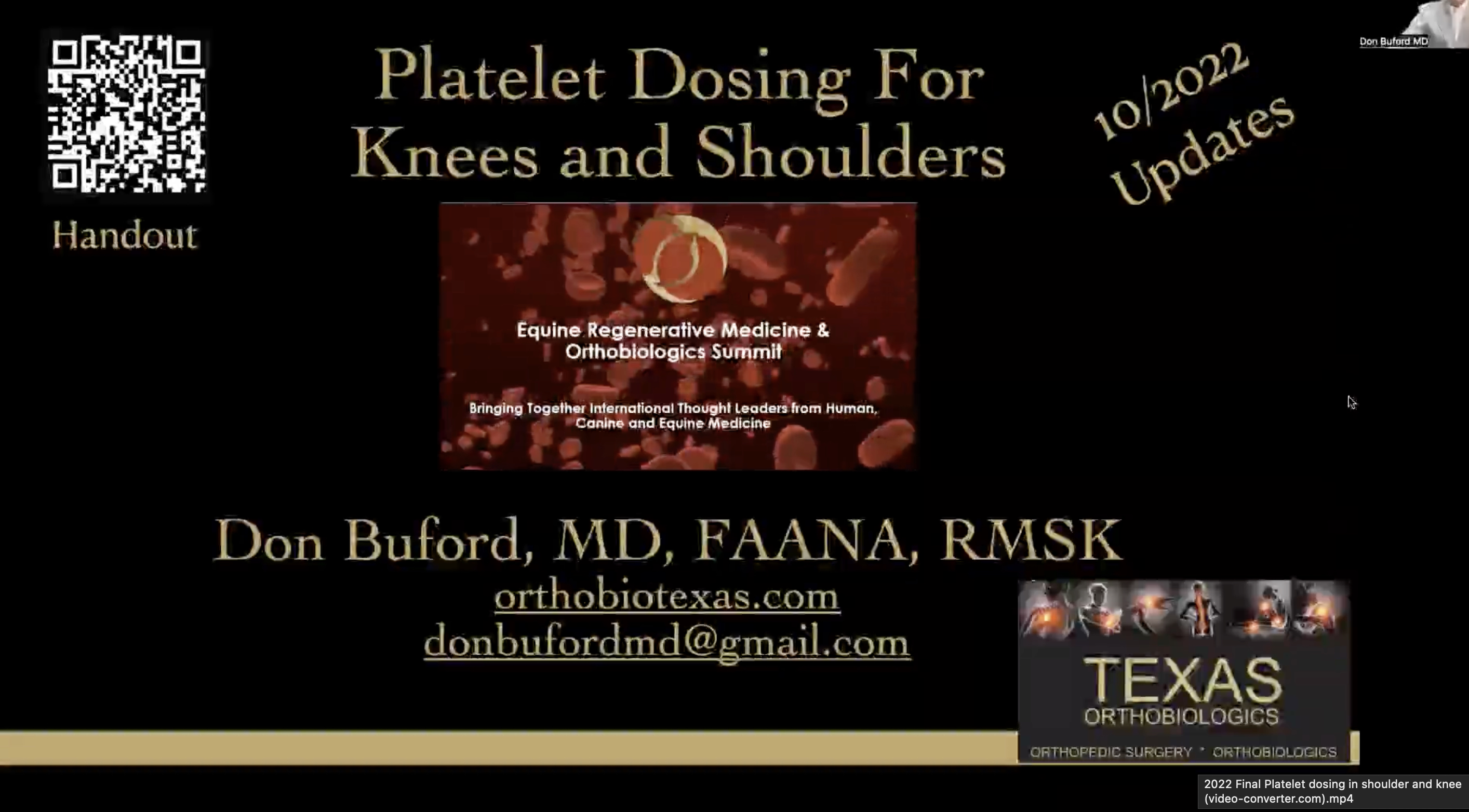
Enjoy and learn from this 25 minute presentation evaluating the most recent data on platelet rich plasma dosing for shoulder and knee conditions coming straight from a summit done October 2022
 Lecture
Dr. Vinod Dasa discusses the new role of physical therapy in total joint replacement.